Introduction
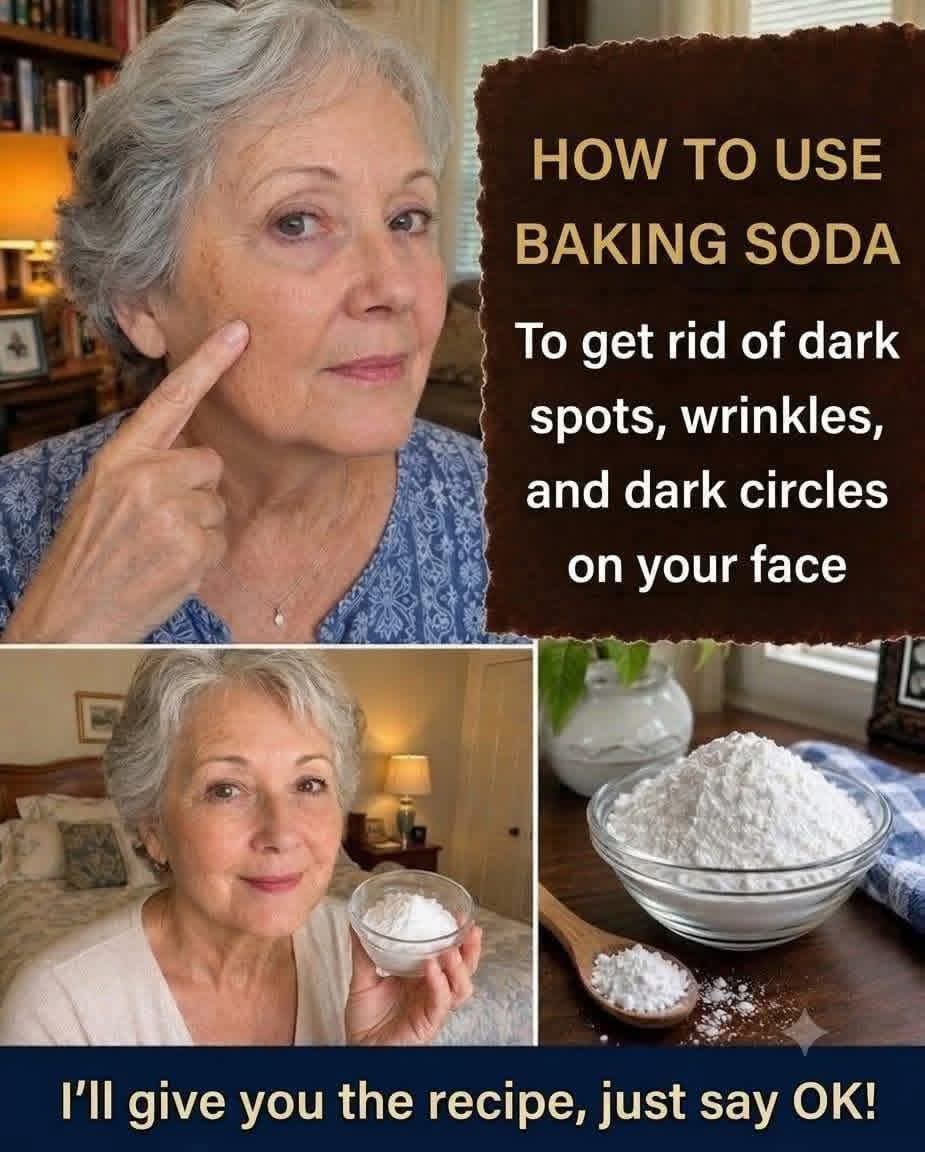
Baking soda is often promoted online as a cheap home remedy for dark spots, wrinkles, uneven skin tone, and dark circles. However, the claim shown in the image is misleading. Baking soda is alkaline, while healthy facial skin normally has a mildly acidic pH. Disrupting that balance can cause dryness, irritation, and damage to the skin barrier.
There is also no good clinical evidence that applying baking soda to the face removes wrinkles, age spots, or dark circles. In fact, irritating the skin can make pigmentation problems more noticeable.
For that reason, this guide does not recommend a baking-soda face mask. Instead, it explains what to use safely if your goal is smoother, brighter, healthier-looking skin.
Recipe Overview
| Category | Details |
|---|---|
| Recipe Type | Gentle skincare routine |
| Main Goal | Support healthy-looking, hydrated skin |
| Suitable For | Most adults when appropriate products are selected |
| Baking Soda | Not recommended for facial application |
| Patch Test | Recommended for new skincare products |
| Morning Routine | Cleanser, moisturizer, broad-spectrum SPF 30+ |
| Evening Routine | Gentle cleanser, treatment if appropriate, moisturizer |
| Expected Results | Gradual improvement rather than an overnight change |
| Difficulty | Easy |
Why You’ll Love This Safer Approach
It avoids harsh DIY ingredients that may irritate the skin.
It focuses on hydration and protection, two important parts of an effective anti-aging skincare routine.
Daily sunscreen can help prevent additional sun-related pigmentation and premature skin aging. Dermatologists recommend broad-spectrum SPF 30 or higher.
It can be adapted to dry, oily, combination, or sensitive skin.
Most importantly, it does not promise unrealistic results such as completely erasing wrinkles or dark circles overnight.
Ingredients
Morning Routine
| Ingredient/Product | Amount | Purpose |
|---|---|---|
| Gentle fragrance-free cleanser | Small amount | Removes oil and impurities |
| Vitamin C serum, optional | 2–3 drops | Helps improve uneven-looking skin tone |
| Fragrance-free moisturizer | Small amount | Supports the skin barrier |
| Broad-spectrum sunscreen SPF 30+ | Generous amount | Helps protect against UV-related aging and pigmentation |
Vitamin C is one ingredient dermatologists may recommend for dark spots, while sunscreen is considered an essential part of pigmentation care.
Evening Routine
| Ingredient/Product | Amount | Purpose |
|---|---|---|
| Gentle cleanser | Small amount | Cleanses the skin |
| Retinol or another appropriate retinoid, optional | As directed | May improve fine lines and pigmentation |
| Moisturizer | Small amount | Hydrates and supports the skin barrier |
Retinoids can be useful for mild pigmentation irregularities and fine lines, but they should be introduced gradually because irritation can worsen dark marks, particularly in people prone to hyperpigmentation.
What About Baking Soda?
| Question | Answer |
|---|---|
| Can baking soda remove wrinkles? | No proven evidence |
| Can it erase dark spots? | No proven evidence |
| Can it remove dark circles? | No |
| Can it irritate facial skin? | Yes |
| Should it be scrubbed onto the face? | No |
| Is it recommended as an anti-aging treatment? | No |
Baking soda should not be treated as a proven skin-lightening or anti-aging ingredient.
Step-by-Step Instructions
Morning
Start by washing your face gently with lukewarm water and a mild cleanser.
Pat the skin dry rather than rubbing it aggressively.
If you use vitamin C, apply a suitable product according to its label directions.
Apply moisturizer while the skin still feels comfortable and hydrated.
Finish with a broad-spectrum SPF 30 or higher. If you are trying to reduce dark spots, consistent sun protection is particularly important.
Reapply sunscreen approximately every two hours when outdoors, and after swimming or heavy sweating.
Evening
Cleanse your face gently.
If you use retinol or another dermatologist-recommended treatment, apply it according to the product instructions.
Finish with moisturizer.
Introduce only one new active product at a time so that you can determine whether your skin tolerates it. Dermatologists specifically recommend testing new skincare products before applying them broadly.
Best Tips
Do not scrub baking soda onto your face.
Do not combine several strong exfoliating products simply because you want faster results.
If a skincare product burns or stings, stop using it unless it was specifically prescribed and your dermatologist instructed you to expect that reaction. Irritation can make signs of aging and pigmentation more noticeable.
Choose gentle, fragrance-free products if your skin is sensitive.
Be consistent with sunscreen. Treating dark spots without protecting your skin from sunlight can make the problem harder to manage.
Best Ingredient Options
For dark spots, dermatologists may recommend ingredients such as vitamin C, azelaic acid, glycolic acid, kojic acid, or retinoids, depending on the cause and your skin type.
For fine lines and wrinkles, sunscreen, moisturizer, and appropriately selected retinoid products can be useful parts of an anti-aging routine.
For dry skin, look for a gentle cleanser and a moisturizer designed to support the skin barrier.
For sensitive skin, keep the routine simple and avoid unnecessary exfoliation.
Recipe Variations
Simple Brightening Routine
Gentle cleanser + vitamin C + moisturizer + SPF 30 or higher.
Minimal Anti-Aging Routine
Gentle cleanser + moisturizer + SPF 30+ in the morning, followed by gentle cleansing + moisturizer in the evening.
Retinol Routine
Gentle cleanser + moisturizer in the evening, with a dermatologist-appropriate retinoid introduced slowly according to product directions.
Sensitive-Skin Routine
Gentle fragrance-free cleanser + fragrance-free moisturizer + SPF 30+.
What to Use Instead of a Baking Soda Face Mask
If your goal is brighter, smoother-looking skin, a professionally formulated skincare product is a better choice than mixing baking soda with water or other kitchen ingredients.
The American Academy of Dermatology recommends gentle skincare because irritation itself can contribute to dark spots.
Make-Ahead Instructions
There is no need to prepare a homemade baking-soda mixture in advance.
Instead, keep your skincare products stored according to their labels and use fresh products within their recommended period after opening.
Storage
Keep skincare products tightly closed and away from excessive heat and direct sunlight unless the manufacturer specifies otherwise.
Do not store homemade mixtures for prolonged periods because contamination and changes in the formula can occur.
Reheating
Not applicable. Facial skincare products should not be heated unless the manufacturer specifically instructs you to do so.
Freezing
Not recommended. Freezing can alter the consistency and performance of many skincare products.
Common Mistakes to Avoid
Using baking soda as a facial scrub.
Expecting a homemade ingredient to erase wrinkles.
Applying several strong active ingredients at the same time.
Skipping sunscreen while trying to fade pigmentation.
Scrubbing dark spots aggressively.
Continuing to use a product that causes persistent burning, redness, or irritation.
Assuming every dark spot is simply an age spot. Pigmentation can have many causes, and treatment depends on the underlying cause.
Nutrition Estimate
| Nutrient | Amount |
|---|---|
| Calories | Not applicable |
| Protein | Not applicable |
| Carbohydrates | Not applicable |
| Fat | Not applicable |
| Sugar | Not applicable |
| Fiber | Not applicable |
This is a topical skincare routine, so nutritional values do not apply.
Frequently Asked Questions
Can baking soda remove dark spots?
There is no reliable clinical evidence that baking soda removes facial dark spots. Dermatologists instead recommend identifying the cause, protecting the skin from sunlight, and using appropriate treatments.
Can baking soda remove wrinkles?
No. Baking soda is not an established wrinkle treatment. Dermatologists recommend measures such as daily sunscreen and moisturizer, with certain anti-aging ingredients when appropriate.
Can I mix baking soda with water and apply it to my face?
It is better not to. Baking soda is alkaline and can interfere with the skin’s normal acidic environment, potentially causing dryness and irritation.
Why did my skin become darker after using a home remedy?
Irritation or inflammation can contribute to post-inflammatory hyperpigmentation. This is one reason aggressive DIY treatments can sometimes make pigmentation worse rather than better.
What is better for dark spots?
Daily broad-spectrum SPF 30+ is an important starting point. Depending on the cause, ingredients such as vitamin C, azelaic acid, glycolic acid, kojic acid, or retinoids may help.
How long does it take for dark spots to fade?
It depends on the cause and how deeply the pigment is located. Some dark spots can take months to fade, and deeper pigmentation can take considerably longer.
When should I see a dermatologist?
See a dermatologist if a dark spot is new, changing, persistent, difficult to identify, or not improving with appropriate skincare. A dermatologist can determine the cause and recommend suitable treatment.
Final Thoughts
The viral idea that baking soda can remove wrinkles, dark spots, and dark circles may sound appealing because it is inexpensive and easy to find, but it is not a scientifically established facial treatment. More importantly, irritating the skin can actually make pigmentation and visible signs of aging worse.
A gentle skincare routine built around daily sunscreen, adequate moisturizing, appropriate active ingredients, and patience is a much safer approach to maintaining healthy-looking skin.
⚠️This recipe may not be suitable for everyone, so it is advisable to consult a doctor.